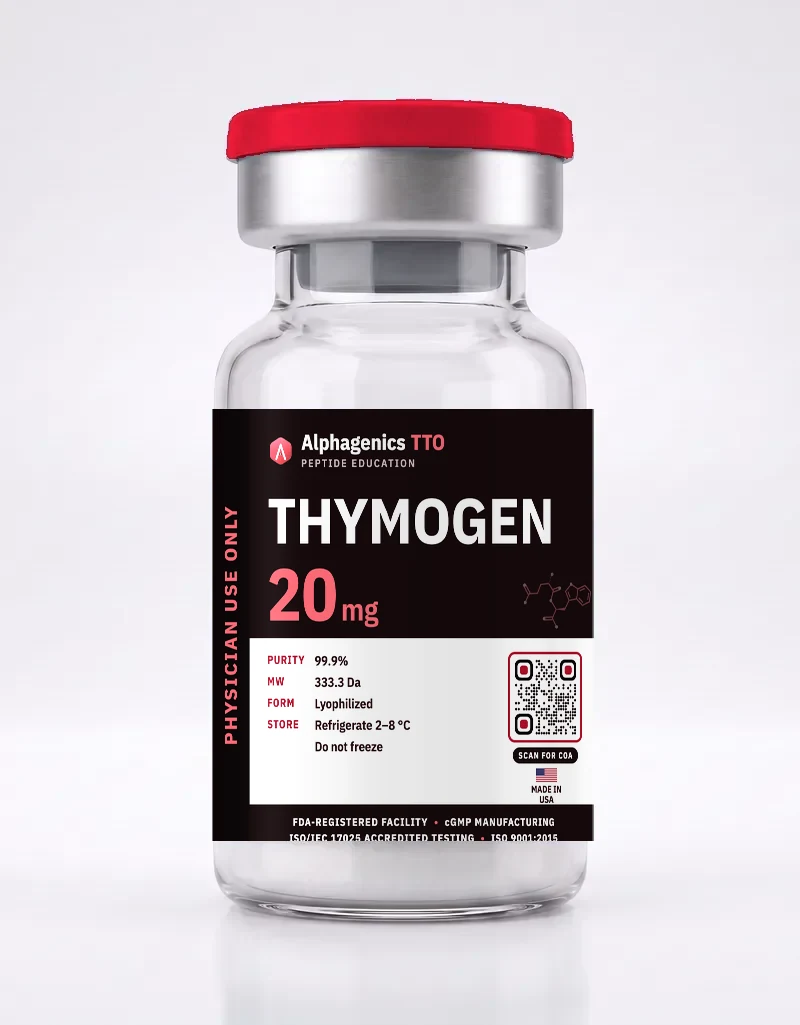
Thymogen
Oglufanide · L-Glu-L-Trp · IM862 · Timogen
Synthetic immunomodulatory dipeptide (α-L-glutamyl-L-tryptophan)
About Thymogen
Thymogen is the synthetic dipeptide L-glutamyl-L-tryptophan (Glu-Trp), with the international nonproprietary name oglufanide.
It was identified as one of the immunomodulatory molecules of thymalin, a peptide complex extracted from calf thymus, by the group of V. G. Morozov and V. Kh. Khavinson in Saint Petersburg, and has been studied mainly in relation to T-lymphocyte function and innate immunity. Most of its literature is published in Russian without an indexed English abstract; this data sheet uses only the studies with an abstract available in PubMed, which are few. Under the code IM862 it was evaluated in the West as a possible antiangiogenic agent in oncology trials, without favorable results in the controlled trials.
Structure and sequence
Sequence

Five findings from studies
Summary of results reported in the scientific literature. Each finding describes what was observed in the cited study, in its specific population and conditions; it does not constitute a therapeutic indication.
-
Review
A review by its developers describes the isolation of L-Glu-L-Trp from thymalin and its development as Thymogen; it has been associated with activation of T-cell differentiation, cytokine secretion (IL-2, interferon) by blood lymphocytes, and activation of neutrophil chemotaxis and phagocytosis.
Morozov VG, Khavinson VK. Int J Immunopharmacol. 1997;19:501-505 · PMID 9637345 -
Preclinical
In 76 female rats, subcutaneous administration of L-Glu-L-Trp for 12 months did not change mean life span, but it has been associated with longer survival of the longest-lived 10% and with a 1.5-fold lower total tumor incidence than in controls.
Anisimov VN et al. Biogerontology. 2000;1:55-59 · PMID 11707921 -
Preclinical
In mice, L-Glu-L-Trp has shown inhibition of tumor growth without direct toxicity to human tumor cell lines; this activity was lost in the absence of NK cells or perforin and was reduced in IL-12-deficient mice.
Smith DL et al. Int J Cancer. 2003;106:528-533 · PMID 12845648 -
Clinical study
In a phase II trial in 25 patients with metastatic renal cell carcinoma, intranasal IM862 (L-Glu-L-Trp) produced no significant objective responses (8 patients with stable disease and 17 with progression), although a decrease in plasma VEGF was observed; no grade 2 or 3 drug-related toxicities were recorded.
Deplanque G et al. Br J Cancer. 2004;91:1645-1650 · PMID 15354209 -
Clinical study
In a randomized, double-blind, placebo-controlled phase III trial in 202 patients with AIDS-related Kaposi sarcoma, intranasal IM862 was not superior to placebo in response rate (23% versus 21%) and was associated with a shorter time to progression; the authors note that concurrent antiretroviral therapy may have accounted for responses seen in earlier studies.
Noy A et al. J Clin Oncol. 2005;23:990-998 · PMID 15598977
Frequently asked questions
What is Thymogen?
Thymogen is the synthetic dipeptide L-glutamyl-L-tryptophan (Glu-Trp), with the international nonproprietary name oglufanide. It was identified as one of the immunomodulatory molecules of thymalin, a peptide complex extracted from calf thymus, by the group of V.
What target or receptor does Thymogen act on?
Immunomodulation (T-lymphocyte differentiation and function; dependence on NK cells in mouse models); molecular mechanism not established
What is the half-life of Thymogen?
Not established in humans
What have published studies observed about Thymogen?
A review by its developers describes the isolation of L-Glu-L-Trp from thymalin and its development as Thymogen; it has been associated with activation of T-cell differentiation, cytokine secretion (IL-2, interferon) by blood lymphocytes, and activation of neutrophil chemotaxis and phagocytosis. (Morozov VG, Khavinson VK. Int J Immunopharmacol. 1997;19:501-505, PMID 9637345) In 76 female rats, subcutaneous administration of L-Glu-L-Trp for 12 months did not change mean life span, but it has been associated with longer survival of the longest-lived 10% and with a 1.5-fold lower total tumor incidence than in controls. (Anisimov VN et al. Biogerontology. 2000;1:55-59, PMID 11707921)
How is Thymogen stored?
Refrigerate at 2–8 °C, do not freeze. Protect from light and moisture, unopened and once reconstituted.
What sizes is Thymogen available in?
20mg