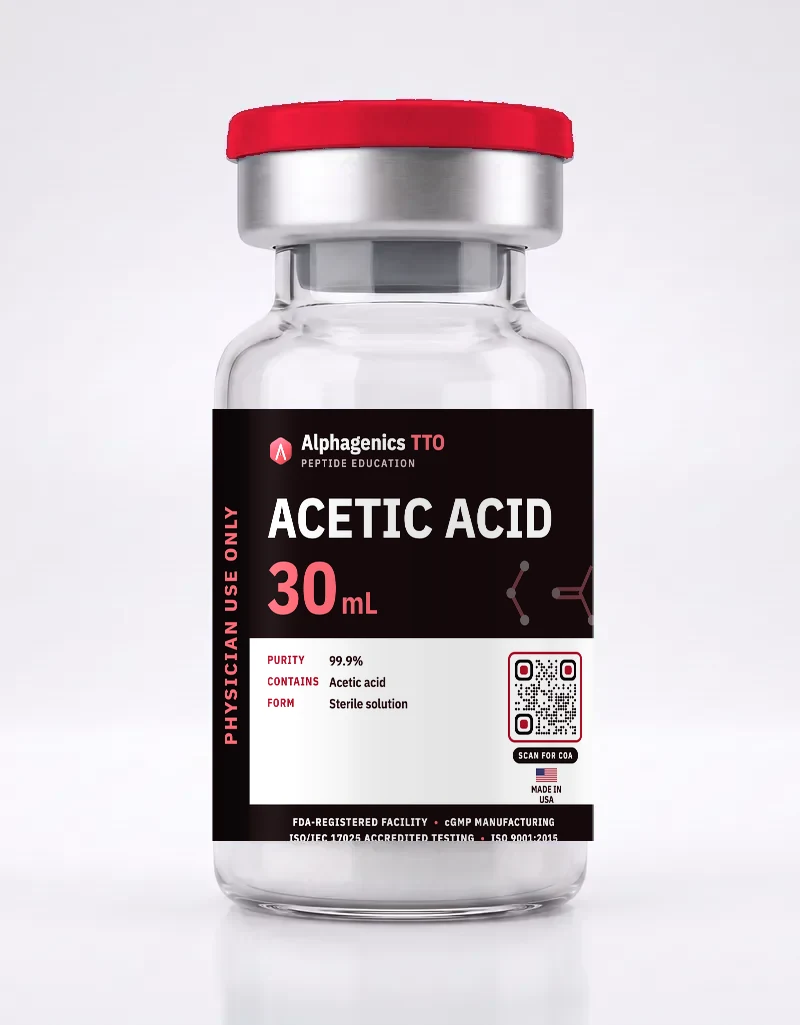
Acetic Acid
Ethanoic acid · Dilute acetic acid solution
Sterile acidic diluent (dilute acetic acid solution)
About Acetic Acid
Acetic acid is a weak organic acid and the main acidic component of vinegar.
This presentation is a sterile, dilute acetic acid solution, in 3 mL and 30 mL vials, used as a diluent to reconstitute lyophilized peptides that dissolve poorly in bacteriostatic water. The solubility of many peptides and proteins depends on the pH of the medium, and some dissolve better in a slightly acidic environment. Outside its use as a diluent, dilute acetic acid solutions have been studied in the laboratory and in the clinic as a topical antiseptic.
Structure and sequence
Structure of acetic acid (CH3COOH, C2H4O2), the simplest carboxylic acid after formic acid; in this product it is diluted in sterile water.
Five findings from studies
Summary of results reported in the scientific literature. Each finding describes what was observed in the cited study, in its specific population and conditions; it does not constitute a therapeutic indication.
-
In vitro
In a formulation study of the chimeric protein AB204 (activin/BMP2), water solubility after lyophilization depended on the buffer used: with sodium acetate at pH 4.5 the pH rose on reconstitution and solubility was low, whereas lyophilization from buffers containing acetic acid or trifluoroacetic acid yielded a highly soluble protein.
Ahn C et al. Protein Pept Lett. 2014;21:426-433 · PMID 24555430 -
In vitro
In a standardized in vitro study with bacteria typical of burn units, 3% acetic acid has shown a broad-spectrum bactericidal effect, particularly against Gram-negative organisms such as Pseudomonas aeruginosa, Proteus vulgaris and Acinetobacter baumannii, similar to or better than common local antiseptics.
Ryssel H et al. Burns. 2009;35:695-700 · PMID 19286325 -
In vitro
In 29 isolates of common wound pathogens, acetic acid inhibited bacterial growth with a minimum inhibitory concentration of 0.16–0.31%, prevented biofilm formation at 0.31%, and eradication of mature biofilms was observed after three hours of exposure.
Halstead FD et al. PLoS One. 2015;10:e0136190 · PMID 26352256 -
In vitro
In laboratory tests, acetic acid, both as a liquid and as a dry salt, has been associated with complete eradication of Gram-positive and Gram-negative biofilms; the authors also describe their clinical experience applying it to chronic wounds.
Bjarnsholt T et al. Adv Wound Care (New Rochelle). 2015;4:363-372 · PMID 26155378 -
Clinical study
In a randomized, double-blind phase II trial in 22 patients with colonized burns, topical 2.0% acetic acid reduced bacterial load more than 0.5%, but was associated with a higher pain score; the only serious adverse event recorded was unrelated to acetic acid.
Moiemen N et al. J Burn Care Res. 2025:iraf228 · PMID 41410357
Frequently asked questions
What is Acetic Acid?
Acetic acid is a weak organic acid and the main acidic component of vinegar. This presentation is a sterile, dilute acetic acid solution, in 3 mL and 30 mL vials, used as a diluent to reconstitute lyophilized peptides that dissolve poorly in bacteriostatic water.
What target or receptor does Acetic Acid act on?
Not applicable (diluent)
What is the half-life of Acetic Acid?
Not applicable
What have published studies observed about Acetic Acid?
In a formulation study of the chimeric protein AB204 (activin/BMP2), water solubility after lyophilization depended on the buffer used: with sodium acetate at pH 4.5 the pH rose on reconstitution and solubility was low, whereas lyophilization from buffers containing acetic acid or trifluoroacetic acid yielded a highly soluble protein. (Ahn C et al. Protein Pept Lett. 2014;21:426-433, PMID 24555430) In a standardized in vitro study with bacteria typical of burn units, 3% acetic acid has shown a broad-spectrum bactericidal effect, particularly against Gram-negative organisms such as Pseudomonas aeruginosa, Proteus vulgaris and Acinetobacter baumannii, similar to or better than common local antiseptics. (Ryssel H et al. Burns. 2009;35:695-700, PMID 19286325)
What sizes is Acetic Acid available in?
3mL · 30mL